All images by Waveslider Photography
New safety works for Bournemouth’s pier may have a huge impact on the surf for the area, as an expert determined the ongoing restoration project, “could deteriorate the wave, which would have a negative effect on the whole surfing community of Bournemouth.”
Initial plans to fully restore Bournemouth pier, home to one of the south coast’s more popular waves, have been scaled back and delayed – due to there not being any suitable contractors. Instead, authorities are aiming to focus on removing deteriorating timber landing stages that currently pose a safety risk.
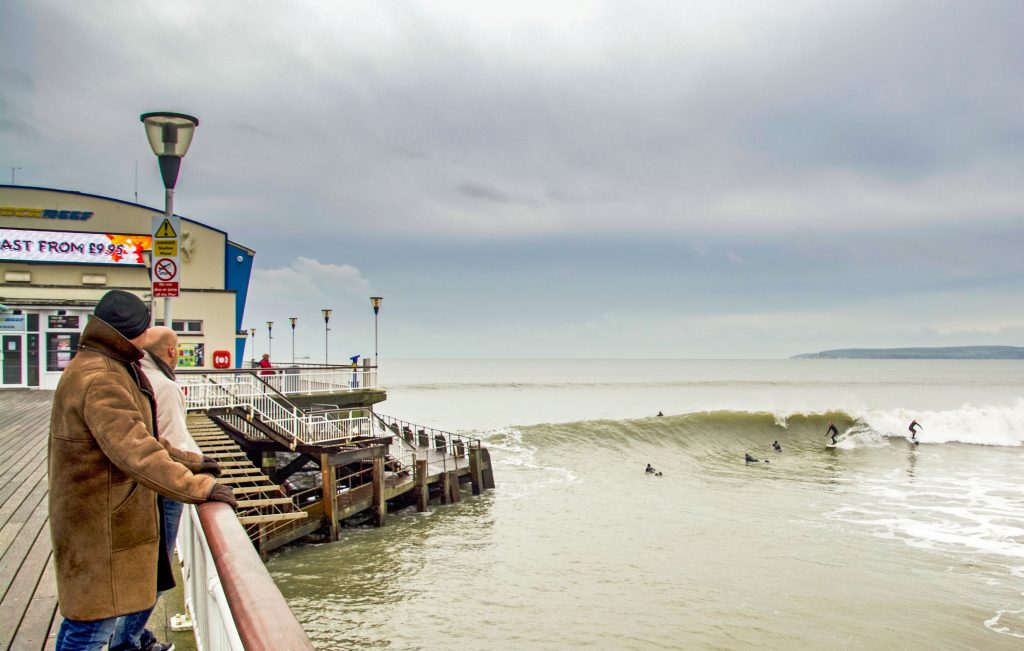
There’s a left and a right running along Bournemouth’s pier. Pick your favourite.
However, campaigners say that if parts of the pier aren’t properly returned to their current state this could post a serious threat to the wave quality at Bournemouth. They also say they understand that the safety measures need to be carried out, but urge them not to impact the quality of the surf.
“Bournemouth’s six miles of beach is at a significant ‘natural’ disadvantage for surf. Poole Bay is relatively sheltered from the swell generated in the Atlantic and has to travel up the channel in order to reach us,” said Richie Inskip, local surfer. “Consequently our waves are generally smaller, weaker and less consistent than those found on the more exposed coasts of Cornwall and Devon. Therefore, any small changes to our (Bournemouth) nearshore environment will likely have a significant large effect on reducing the quality of surf we receive.”
Ocean scientist Tony Butt, said the works could pose a serious threat to wave quality. “Due to its interaction with the incoming swells and second-order effects on the local bathymetry, the pier helps to create an area of vastly-improved surfing waves in a coastline that would otherwise contain very poor quality or unsurfable waves,” said Tony, who wrote the book on Surf Science (it’s literally called Surf Science, you can find it online).

Well-known amongst the locals, Bournemouth pier has been a staple surf spot since the 1960s.
“The presence of such a structure combined with the prevailing oblique-angle wave approach, alters the hydrodynamics and creates a semi-permanent system of rip currents which, in turn, maintain a sandbar adjacent to the pier. The sandbar is a key feature for improving the surfing wave; it allows the wave to break right and left, and can, under certain circumstances, amplify the wave height. At the same time, the pier is also essential for blocking the prevailing sideshore and side-onshore winds, creating a windless area in exactly the same place as the sandbar.
“The lower platforms, which form an important part of the structure of the pier, probably have some influence on the above mechanisms, although to be more specific would require mathematical modelling. What we do know is that the pier, in its present form, has produced consistent surfing waves since surfing first came to Bournemouth in the 1960s.”
Essential safety works are important to be carried out. And Richie acknowledges the need for them, however the plans should details how the surf will be retained: “We just need to know that surfing and the preservation of our waves is recognised by the local authority,” said Richie. “We also want reassurance and commitment to protect our waves in from works the council plan to carry out.”
The works on the pier began on September 21. It’s hoped that once complete, they will extend the life cycle of Bournemouth’s pier by up to 25 years.