Words by Dom Moore of Surf Sanctuary. Images courtesy of Geoff Tydeman.
For decades the Cribbar has lived in the shadow of its louder Atlantic cousins, but in raw power per square foot, it still sits in the upper tier of European spots.
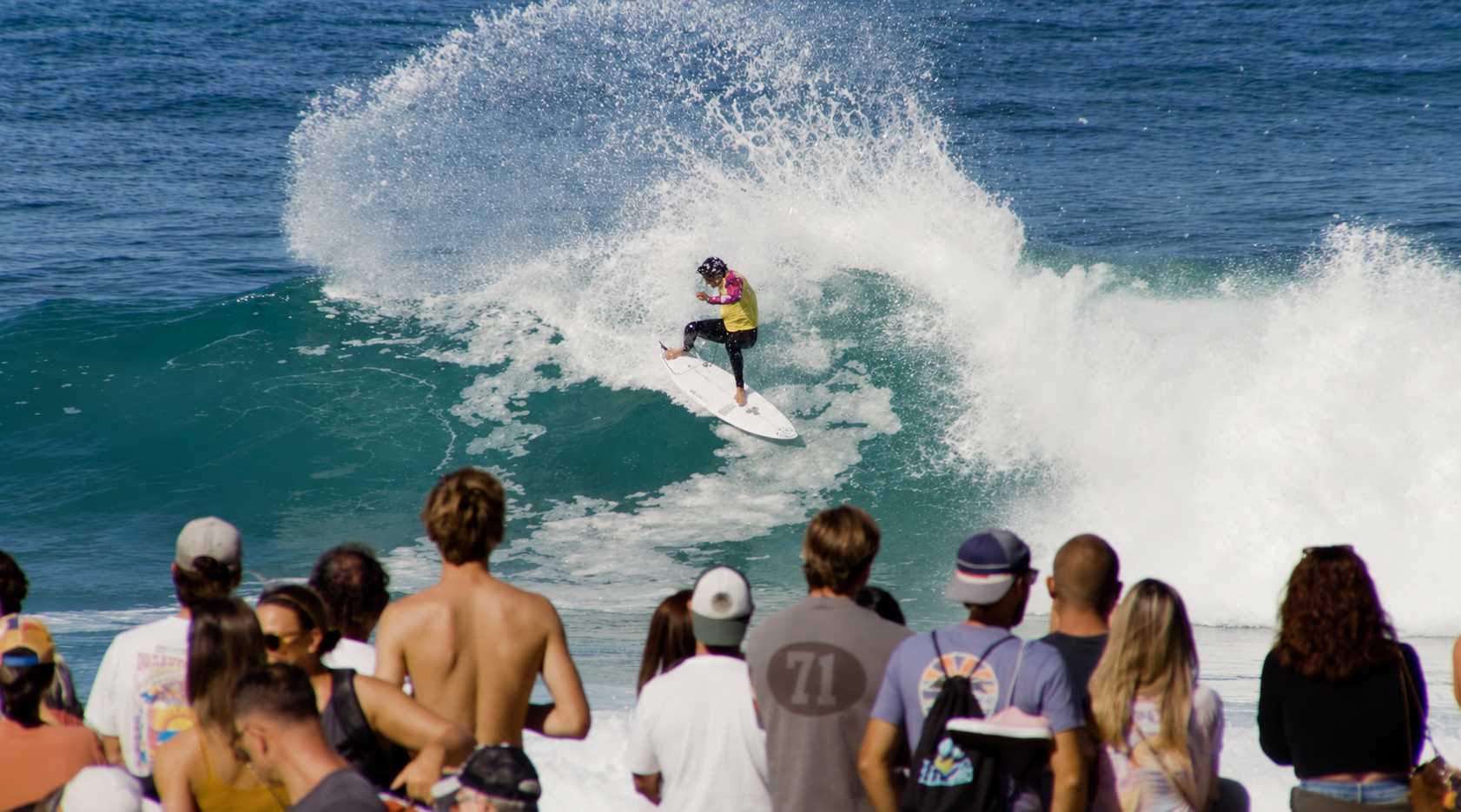
Breaking in plain sight from Fistral Beach, itself one of the best-known surf spots in Northern Europe, thousands have watched its primeval bombs detonate across the flats of the reef. Yet in comparison to its notoriety (and at times, derision), the Cribbar may be the least surfed wave in the UK. Its blend of a quirky ride and a frankly dangerous setup tips the balance of risk and reward out of favour for most. But you don’t have to surf it to understand it; the Cribbar reveals the fundamentals of how powerful waves break.

Splitting the peak when it’s double overhead, except one runs into a channel, the other into the headland — if you’re unlucky.
Bathymetry
Other than how big the wave will be, the first thing most people want to know is what lies beneath the surface at the Cribbar. Tales persist of entire boats lost to the depths, their rusting engines wedged into cracks in the rock. In truth, it’s a fairly typical kelp-covered reef: long and narrow, rising from a sandy seabed on either side. The best way to picture it is as the headland itself, carrying on underwater and tapering out to sea.
At spring low tide, the depth drops from around eight metres over the sand on the approach to roughly three metres across the reef. That change in depth is unlike anything on nearby beaches. Right in the centre of the reef, where the main take-off zone sits, a large boiling patch of water marks the shallows whenever a set breaks. It’s a little shallower again right there.
The fabled deep crevices and overhanging ledges do exist, but they’re tucked further in on the headland itself. So, could you hit the bottom on a big wipeout? Yes. Could you get wedged into a cave and never be seen again? Hypothetically, yes.
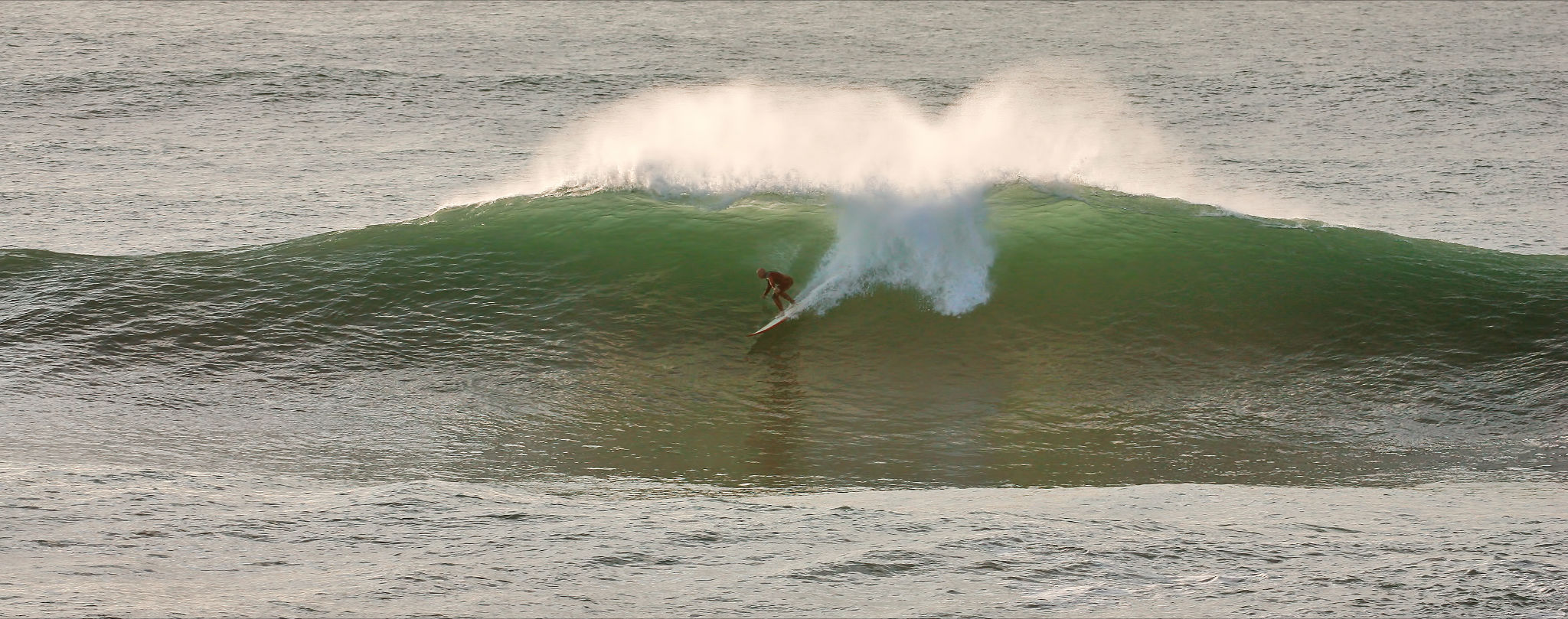
There’s a certain size it can feel like a lot of fun out there. Experts only though.
The Cribbar’s underwater story stretches much further out to sea. Another reef lies about 800 metres offshore. The last time it showed any class was 1st February 2021, when Tom Butler rolled into a monstrous right-hander in front of a lockdown-weary crowd on the headland. Beyond that point, the seabed drops quickly to around 30 metres, then gradually down to about 150 metres deep, some 350 kilometres offshore. By comparison, Sligo reaches that depth at around 130 kilometres, and Nazaré – thanks to its canyon funnelling straight towards Praia do Norte – hits it just five kilometres from shore.
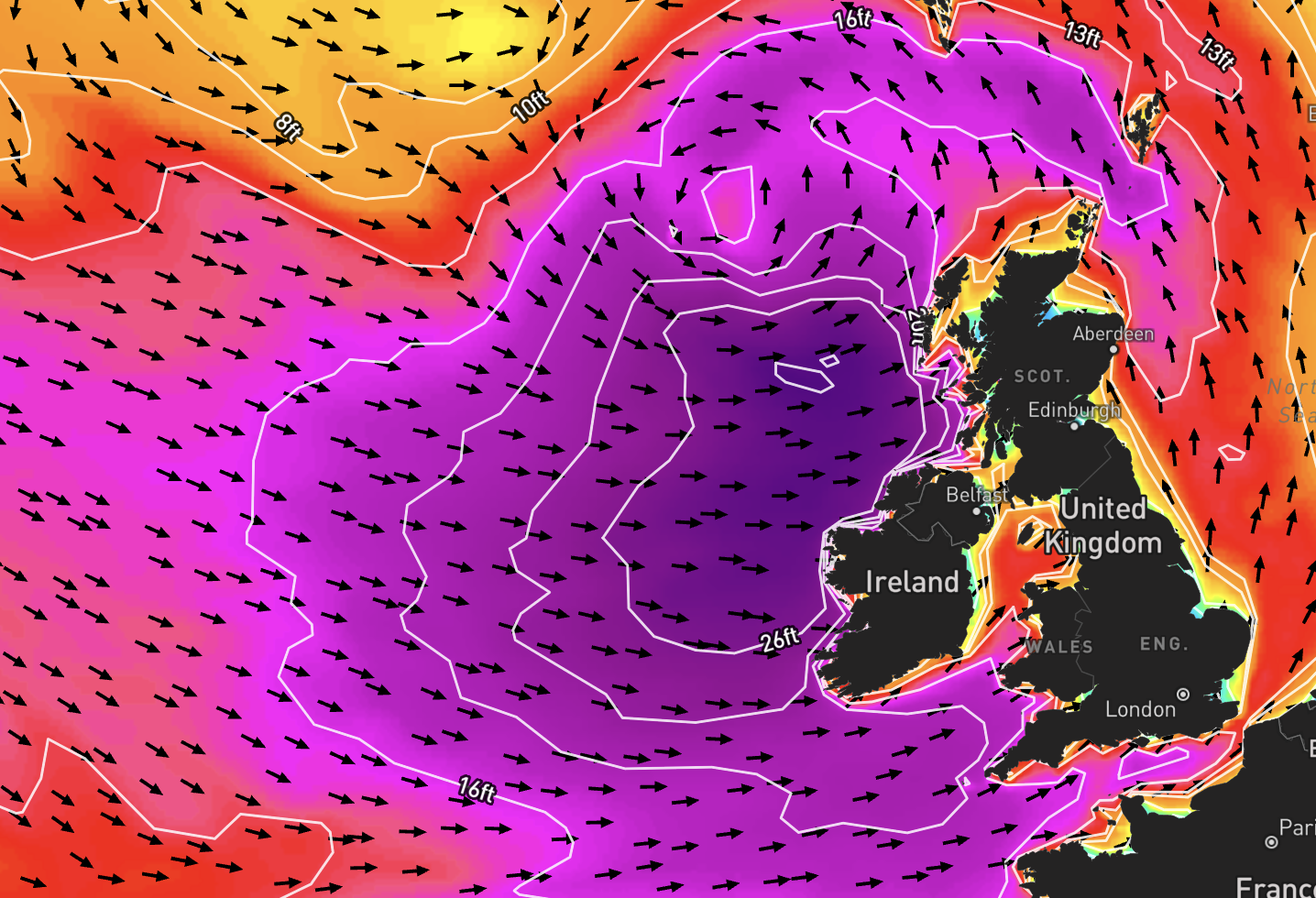
That 150-metre contour matters. It’s the point where a 14-second period swell begins to feel the sea floor. As the swell approaches the Cribbar, it slows, energy is lost to friction, and the process of shoaling begins. The wave may be shedding energy, but the water piles up, and height increases dramatically. Shoaling compresses the energy into a steeper, more powerful form.
Swell height
Because the reef still sits around two-and-a-half-metres deep, even on the lowest tides, the Cribbar needs a swell height of at least two metres to come alive. As a rough guide, waves begin to break in water roughly 1.3 times their height, so a two-metre swell will start breaking in about 2.6 metres of water – right over the boiling section of the reef. If the low tide isn’t especially low, say one and a half metres instead of half a metre, a larger swell is needed to compensate for the extra depth above the boil.
Swell period
If the minimum swell height is covered, we can turn to the swell period. The short version is simple: the longer the period, the better. The Cribbar rarely breaks properly on anything under 12 seconds, and in my experience, it starts to get good from 14 seconds and upwards.
The longer version is that the swell period determines the depth at which the swell begins to feel the sea floor (see maths box #1 below). This depth is known as the wave base, equal to half the wavelength. A 14-second swell has a wavelength of around 300 metres, which means its wave base sits roughly 150 metres deep. Once the swell reaches that depth, interaction with the sea floor begins. The wave slows and loses energy. This is the first stage of transformation that eventually gives us the Cribbar’s distinctive shape and power.
Maths box #1: find the wavelength
To find the wavelength of a swell, you need to know its period and speed. We already have the period: 14s
To find the speed in m/s, we use a derived constant 1.56 (the longer maths is not required here) :
Speed = (14 s) x (1.56) = 21.84 m/s
Now we know the speed of the swell. Multiply the speed by the time it takes between each wave passing a fixed point, which is of course the period – 14 s:
Wavelength = (21.84 m/s) x (14 s) = 306 m
The wave base is half the wavelength, which is 153 m, but we’ll call it 150 m with change.
The second effect of this slowing is that the swell begins to bend towards deeper areas. You can picture ocean swells as long, straight lines sweeping across the sea. When the depth beneath them is constant, every part of the swell moves at the same speed.
But when one section meets shallower water, it slows and loses energy through friction. It’s a bit like a car freewheeling down a hill: if one of the front tyres suddenly loses air, the car veers in that direction. The same thing happens to waves. Swell lines wrap around shallower areas, their energy focusing through concave refraction.
The Cribbar is a striking example of this effect. It’s why, even though the same swell will produce bigger waves at Mullaghmore or Nazaré, foot for foot the Cribbar still packs remarkable power. And by understanding concave refraction, we can also start to understand how to approach waves like it.
You might wonder why a low-period swell, with its shallower wave base, wouldn’t be better since it loses less energy crossing the continental shelf. The reason is that low-period swells don’t create the same shoaling effect, so there’s less water being pushed upward to detonate on the reef. Just as crucially, low-period swells travel more slowly (see maths box #2). Power is a function of speed, which means higher-period swells hit harder than shorter-period swells of the same height.
Maths box #2: know your energy
To calculate the energy of a swell, we need to know its height and the wavelength. The height is given in any surf forecast, and we now know how to find the wavelength.
Relative energy = height2 x wavelength
So for a 3 metre 14 second swell, we would get:
Relative energy = (3m2) x (306m) = 2754
Meanwhile, a 3 metre 9 second swell gets:
Relative energy = (3m2) x (125m) = 1125
The 9 second swell has less than half the energy of the 14 second swell.
If you want to know the real-world energy of a swell in Joules, multiply the relative energy by the constant, 1256.76. This constant itself is derived from water density and the gravitational constant, but we don’t need to get into that here.
So, at 3 metres and 14 seconds, the swell energy is 3,461,117 Joules. At 3 metres and 9 seconds, it’s 1,413,855 Joules.
How to take off
When the swell lines reach the Cribbar reef, they bend inwards, concentrating the wave’s energy and increasing its height as it converges on a central point. It’s like sunlight being focused through a magnifying glass until it ignites paper. In the water, you feel this as a sudden heaving of the sea beneath you, a steep wall rising almost vertically; the moment you can choose to paddle in if everything feels right. The take-off point is incredibly precise because of how narrow the reef is. Move just a few metres either side and the wave is still big, but too sloping to catch; the swell is still moving fast in deeper water.
You have to sit right on the boil and face down the sets like a matador. What could go wrong with that? Sooner or later, you’ll get caught inside, take a two-wave hold down, and come up to find your board snapped after being rag dolled for fifty metres underwater in complete darkness. That’s when it pays to remember exactly what the tide and wind are doing.
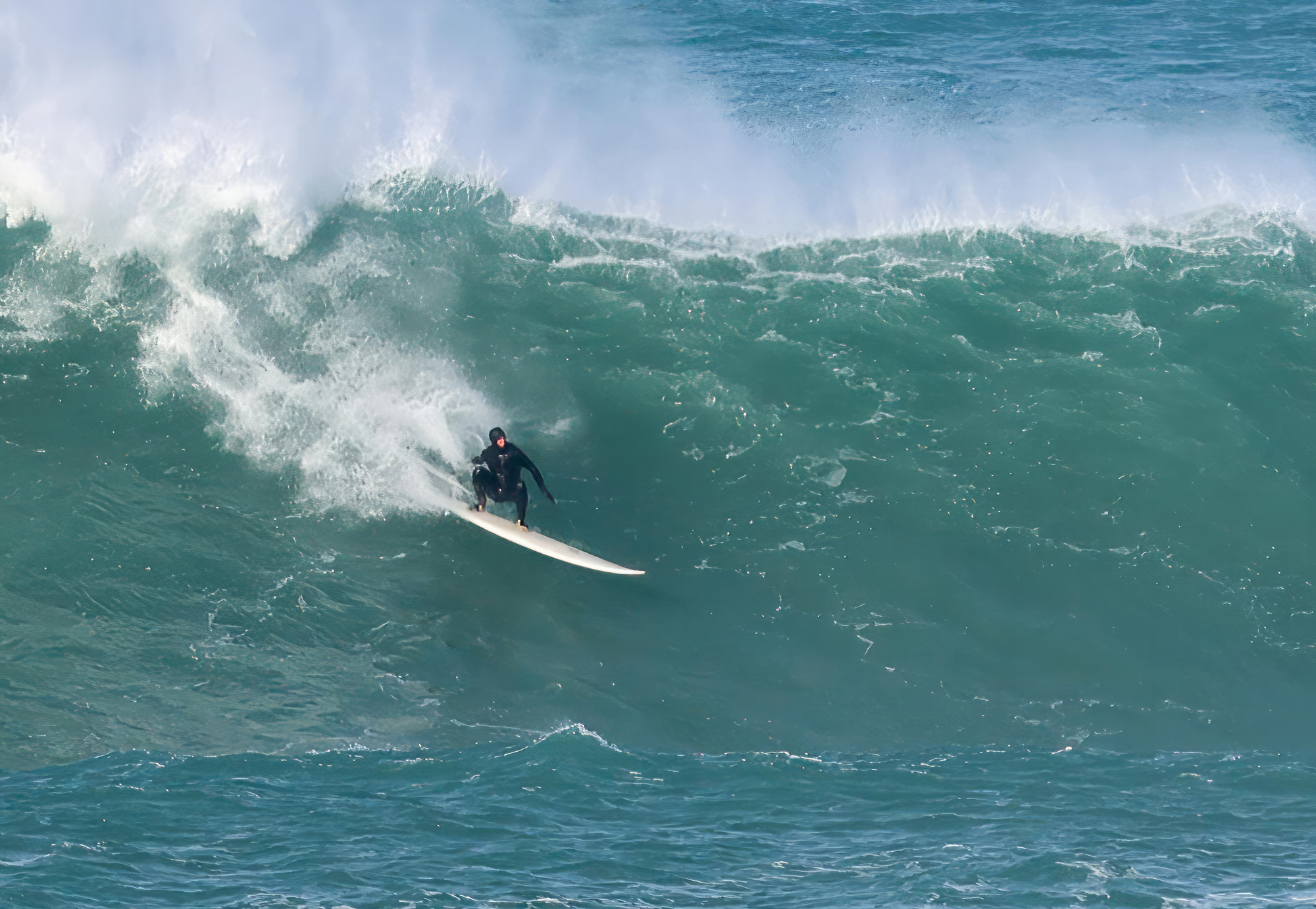
Don’t worry about what you’re doing out there, run and gun can feel more like survival stance at times.
Tide and wind
Unlike the bathymetry or swell, there’s nothing especially unusual about the tide and wind setup that produces good Cribbar waves. It needs a properly low tide to bring the depth over the take-off zone to around two and a half metres, which happens every couple of weeks on the springs. Like any west-facing spot, the Cribbar prefers an offshore wind – not the most common setup, but not rare either.
When you find yourself swimming in after snapping a board or leash, it helps to know whether the tide is rising or falling. A rising tide pulls you round toward the Gazzle; a dropping tide drags you toward Fistral. Depending on whether you wiped out going left or right, you’ll have to decide whether to swim with or against it to get clear of the rocks.
The same applies to the wind. A south-south-easterly will push you round to the Gazzle, while an easterly sends you toward Fistral. It can be the difference between being dragged back into the impact zone for a forty-five minute slog, or an easy scull home.
Where next?
Although Mullaghmore and Nazaré seem like the obvious comparisons for a big unruly wave, the Cribbar has more in common with places such as La Santa in Lanzarote and Sunset Point on Oahu. Here, you’re dealing with an awkward paddle out along the reef edge, a tightly focused take-off zone, strong currents that pull you out of position, and sets swinging in from different directions.
The wave itself is rather unique. The left offers a more predictable entry and can deliver a decent-length ride. The right flattens quickly after the drop, but if you take off deep under the hook and make it out, the surge of adrenaline feels like being struck by lightning.
So now you know how it works, you might start thinking about getting a board shaped for the occasion, and giving yourself a couple of years to get ready. There’s no rush; it will always be there, waiting.
***
Surf Science clinics at Surf Sanctuary in May and October 2026 explore these same principles of power, control, and mindset in depth. Go here for details.