“Britain is a proud surfing nation, and we have some phenomenal athletes who, with the right support, have the potential to become Olympians and World Tour surfers.”
Will Nelson is settling into his role as Head of Operations at the UK’s governing body of surfing, GB Surfing. The organisation, in its current form, has only been running a couple years. Structures are in place, plans have been made and the team is executing against a goal — to create Olympians and World Tour-level surfers. Although the UK coastline is packed with quality waves, the country still hasn’t breached the mainstream as a serious surf contest contender. We’re the other guys, pushing a very big boulder up a very steep hill.

Dills delivering feedback to Lukas Skinner and Stan Norman. Photo: Lucy Gibbins.
“But we are proud to be the underdog,” said Will. “We’ve come from a nation not traditionally known for elite international shortboard surfing, but we work harder, think smarter, and build stronger, consistently making heats, making finals, and making history. And we want to quietly develop a high-performance programme that competes against the odds, defying expectations to earn its place among the world’s elite.”
And that does not happen overnight, nor does it happen with a team who cannot see the vision. Working alongside Will is GB Surfing Team Manager Gwen Spurlock and Performance Coach, Luke Dillon. Two surfers who know how to go the distance in heats and understand the nuanced pressure cooker of competitive surfing.
But what does it take to make an Olympian?
“We are focussing on three key principles,” said Will. “Giving surfers access to the best coaching, on the best waves with the best equipment. There are some incredibly skilful surfers in the UK, and we now in a position to help maximise their talent and give them the support, tools and guidance needed to compete and succeed at the highest level.
“In 2024 we ran nine training camps which included over 40 individual surfers and provided coaching support at seven competitions. This worked out at over 120 days of GB Surfing led activity, with the Progression Squad receiving over 90 days of coaching.
“We are however a decentralised programme, so the work done outside of GB contact time is equally important. Luke will run sessions in Newquay as well as travelling to Wales and we have been impressed by the hunger from the squad to enter additional competitions and work on learning from previous camps in their own training.”

Meet Will.
To help bolster rising talent through the GB Surfing programme, the Progression Squad has been set up, which currently includes Alys Barton, Ellie Turner, Patrick Langdon-Dark, Stan Norman, Lukas Skinner and Charlotte Mulley. These athletes have the aim to make podiums, to make the surfing elite and push the ceiling of GB Surfing.
“The other thing to remember is that being a GB Surfer on the Progression Squad doesn’t entitle you to automatic national squad selection for the ISA World Surf Games,” said Will. “We have a completely separate selection process. Lauren Sandland is a great example. Lauren wasn’t in the Pro Squad but had an incredible GB Cup win in Newquay in 2023, and therefore qualified for our ISA Team. [Lauren has since gone on to be in the Progression Squad]. This year we have also included a place in the ISA squad for the best finishing male and female at the Euros.
“This means surfers have got to turn up and compete when it matters. As well as keeping them focussed and motivated, if is a great way of adding even more pressure to an event simulating Olympic qualifiers.”
Perhaps one of the biggest challenges facing GB Surfing comes from outside the water. A legacy of complex qualification bureaucracy may have soured public perception over the years. But now, GB Surfing is the governing body for all Olympic hopefuls in surfing.

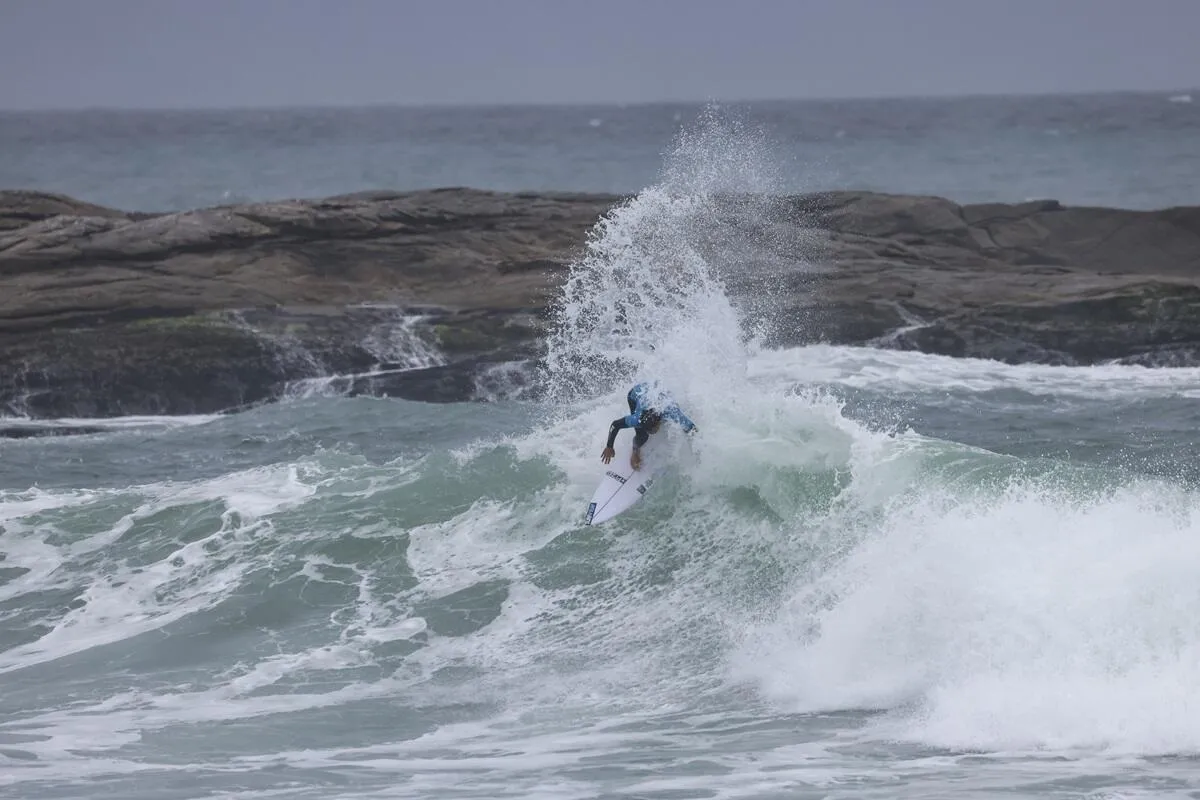
Alys Barton, one of the UK’s hardest-working surfers. Photo Luiz Blanco.
“When surfing was added to the Olympics ahead of Tokyo 2020, Britain was required to form a GB entity to enter Olympic qualifying events. British Surfing (now GB Surfing) was formed by the Home Federations of England, Scotland, Wales and the Channel Islands to select and manage any Great Britain surfing team competing in ISA and Olympic qualifying linked events,” said Will.
“We are fortunate to receive grant funding from UK sport, but this is only for Olympic surfing. It means we can only currently invest in shortboard surfing with a focus on the higher end of the talent in the UK.
“Although our immediate focus is on the elite British shortboarders, our strategy is to create a sustainable programme that delivers Olympic success by the Brisbane games in 2032 and beyond. We are therefore very aware of the need to invest in the pathway and help work with the Home Nations to raise the standard of the groms coming through.”
That investment is not a platitude. “Luke’s in regular communication with the junior coaches and is also planning to visit a number of junior training camps around the UK as well as the various attending junior championships,” said Will. “He was up in Edinburgh with the Scottish junior and senior squad in May, and found it incredibly useful to work with Suds (Craig Sutherland) the Scottish coach and see the brilliant work Scottish Surfing is doing.
“It is so important that we are all aligned, and a connection with the Home Nation coaches will help give us a better understanding of the up-and-coming talent that is out there and enable us to work with them to help surfers progress onto the progression squad and beyond.”
It all plays into the bigger picture here: to develop athletes capable of winning Olympic medals, with clear progression pathways through to the Olympics. All that is no easy task, and can require significant investment.

Making a team. The GB hopefuls. Photo: Lucy Gibbins.
“We are working tirelessly behind the scenes to make this happen,” said Will. “We thoroughly enjoyed working with Aussie, the Proctor & Gamble hair care brand, who have been a valued supporter for the last two years. The more money we can raise, the more opportunities to develop we can offer our surfers and other surfers climbing the pathway.”
The past few years have helped build solid foundations for the progression squad and the team as a whole. “And we’ve already made significant progress — this is just the beginning,” said Will. “We’re incredibly excited about the next four years as we build towards the LA Games, and we’re already planning for future development leading into the Brisbane 2032 cycle.”
As for how Will would like other nations to think of GB Surfing? “We want the world to think of GB Surfing as a challenger with purpose, built on resilience, innovation, and unity.
“This journey is a true team effort, and we’ve launched a membership programme for people who want to actively support our surfers and be part of their future success. We’re also seeking commercial partners who share our values, ambition, and challenger mindset — to help elevate British surfing and make our athletes global leaders in the sport.”
***
Wavelength is a not-for-profit gig, but you can help support the cause by subscribing to our wonderful, twice-yearly mag. Go here for details.