Interview with Matt Barr: Behind ‘The Announcement’
By Bella Bunce
28th March 2025
Stop scrolling, grab your headphones, and dive into ‘The Announcement’ by Matt Barr. This explorative podcast series might seem targeted at the corporate world, but Matt’s inquisitive and fresh approach to the topics of consumerism, climate change, ‘business for good’ and democracy creates something that resonates with everyone.
Whether you’re a number cruncher, entrepreneur, economics enthusiast, or simply an outdoor adventurer seeking a better way forward, this three-part series delivers uncomfortable but necessary truths.
The outdoor sports and lifestyle industries can sometimes become neglectful of the environment. In ‘The Announcement,’ Matt, creator of the popular ‘Looking Sideways’ podcast, expertly unpacks Patagonia founder Yvon Chouinard’s decision to transfer his $3 billion company’s ownership to a trust and nonprofit dedicated to fighting climate change.
This move effectively makes ‘Earth’ the company’s only shareholder, redirecting approximately $100 million in annual profits to environmental causes.
“When Chouinard announced this decision, it sent shockwaves through the business world,” Matt said, when I caught up with him recently. “I wanted to explore not just the mechanics of this transfer, but what it means for how we view the relationship between business, politics, and environmental responsibility.”
You can listen in on all major podcast platforms including Spotify and Apple Podcasts, or visit HERE for more information.
Here, I picked his brain a bit more to get the skinny on the whole thing.
Bella Bunce: What drove you to take on such a big project?
Matt Barr: The original ‘announcement’—‘Earth is now our only shareholder,’ as Yvon Chouinard put it – got a lot of publicity at the time. By publicity, I mean it got shared a lot on social media, and I noticed straight away that there was quite a polarised reaction to it. I’m generalising, but broadly speaking people who’d read ‘Let My People Go Surfing’ [Chouinard’s book exploring how business can be a tool for environmental and social change], and had bought into the idea of Patagonia and Yvon Chouinard leading the way, loved the idea.
Then you had the other end of it, with people saying ‘No, it’s a tax dodge. It’s just a blag.’
Which is basically how everything is debated these days, in this completely binary way. I knew it had to be more complicated than that. I wanted to understand what actually went on, why they did it, and how to address the scrutiny that they received.
But more than that, I wanted to look into if their claims were true. Was this decision really going to ‘change capitalism’, as they claimed?
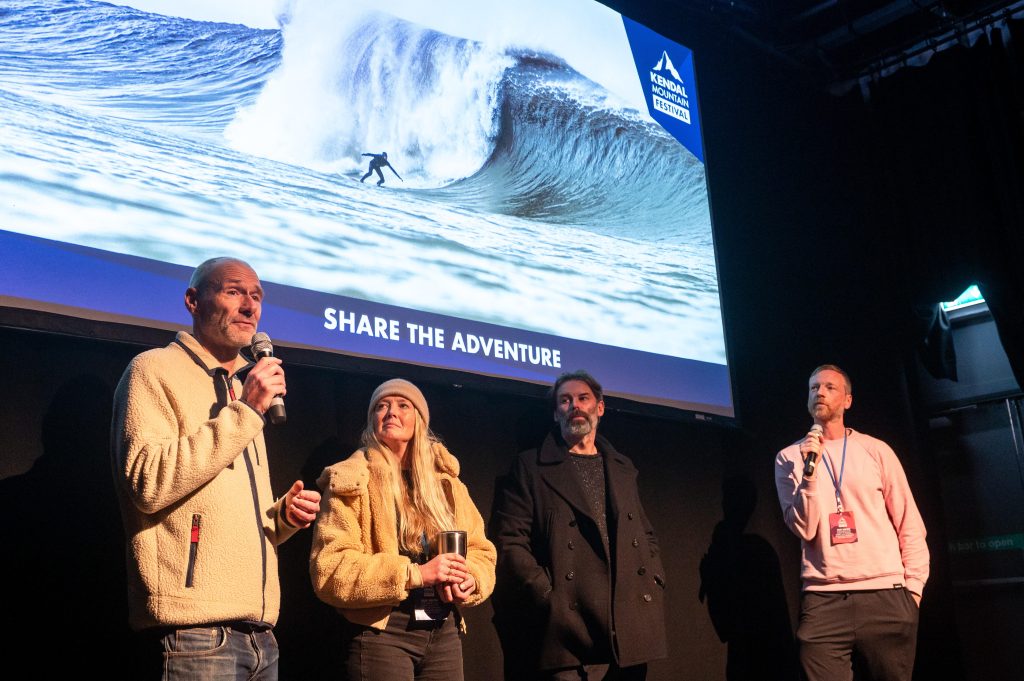
Matt (right) with Chris Nelson, Demi Taylor and Lewis Arnold, creators of the Big Sea documentary casting a light on the dangers of chloroprene. Photo: Harry Atkinson.
BB:A project like this requires a non-biased journalistic integrity and a lot of honesty. Did Patagonia fund it?
MB: Patagonia sponsored a previous podcast of mine called ‘Type Two,’ which ran for 5 years. And when I first had the idea of The Announcement, the company did initially support the project financially.
However, after an initial trip to Ventura, where I conducted most of the interviews that formed the basis for episode 1, we came to the decision that this should be a different thing, not presented by Patagonia and not swayed by brand support. So since then it’s been very much independently done by myself. I began in Spring 2023, and it has taken a couple of years altogether.
I was also motivated to challenge myself creatively and do something hard, so doing it alone felt right.
BB: What is your main takeaway from the podcast? How do you hope it influences business and individual moral decision-making?
MB: One of the things that I came away with from the series is that there are a lot of ineffective things done in the name of sustainability and activism.
The way I look at it now is if you care about an issue and you want to change that issue, you really need to ask yourself a simple question, ‘What can I do that will actually make an impact on that issue and make a change?’ And be prepared for a potentially uncomfortable answer.
“The answer, in their case, was ‘We’ll give all our profits away.’ They made something up that worked better,” — Matt Barr
For example, what most companies do is go through the B Corp process, because that’s what you do if you’re a company that seeks to ‘make change’. But, as Erinch Sahan from Doughnut Economics puts it in episode 3: is this really going to have an impact on the thing you care about?
That’s why I admire Patagonia’s decision—having already been down the B Corps route, they really did ask themselves that question clearly: ‘How can we actually have an impact here?’.
The answer, in their case, was ‘We’ll give all our profits away.’ They made something up that worked better. They didn’t just follow the status quo.
So with all that in mind I was really interested in understanding how ordinary businesses could also try to have an impact. Because obviously not everyone can do what Patagonia did.
On a personal level, it’s certainly impacted the way I do things. I run a marketing agency called All Conditions Media and we’ve made the decision to go employee-owned, rather than follow something like the B Corps route.
In our case, it makes sense to us as a really tangible way to have an impact: to move away from traditional capitalist models where all profit simply goes to the owners. This way it’s more equitable, and means that the staff benefit from the work they are doing. It’s more about giving the employees a voice in how the company is run, so that it isn’t just about pure profit. Given what we do as a business, this seems a more impactful move for us.
Another key theme of the series is about enabling us to have more complicated opinions about complicated things. Rather than just say ‘That’s shit, that’s good.’
Boiling everything down to left versus right, good versus evil, tax dodger versus saviour is just not that helpful anymore.
Matt’s a surfer too of course, like here, at The Wave.
BB: Coming from a board riding background, were you prepared for the process of it all, delving into the economic sphere? Discussing the side to sportswear companies the average customer would never imagine bringing up to a fellow friend, let alone with mic in hand?
MB: No, I wasn’t at all. And it became quite apparent early on it wasn’t a story about the outdoor industry or the surf industry. It was a story about philanthropy, capitalism, democracy, about how money is moved around. And the importance we place on things like the environment, sustainability and the free market.
So I was quickly aware that it would have to be taken seriously by those worlds. Because people who are active in the world of corporate philanthropy would need to listen to and find it valuable.
So one of the challenges of making it was working out how to pitch the series for what are ultimately very different audiences. There’s the surf and outdoor community that I sort of come from, and then this whole other community that would listen because of the subject matter.
They didn’t know anything about who I was, so I had to understand and work out how to communicate these topics quickly and in a way that would be taken seriously.
BB: That’s what I found interesting about your approach with this podcast, as you have managed to blend two worlds, and as a surfer who knows little about the nuances of business and corporate culture, you still had me listening. How was it received by the different communities?
MB: That’s been one of the nicest parts about it really. How seriously it has been received from the world I don’t come from. It’s been seen as a good contribution to the overall topic, by people who really do know what they’re talking about.
BB: I guess you have approached this topic in a different way, using your roots and lens to pose a new outlook.
MB: That’s why things like surfing and the outdoors are great ways into complicated subjects, to give new viewpoints. And the people in those corporate worlds have found that refreshing.
There’s room for a lot of these conversations, isn’t there? I mean surfing is a great vehicle to look at a lot of different topics. ‘The Big Sea’ is a really good example of surfing as an effective way into a bigger picture topic.
But yes I’ve been pleasantly surprised by how closely people have listened. It’s three hours long and quite a big ask for people. It’s not reading or sharing an Instagram post. And ultimately that’s how we get a lot of our opinions these day. If you’ve got a view on Trump, Yvon Chouinard, or the WSL you’ll post something on socials. So it’s actually really hard to ask people to listen to something like this.
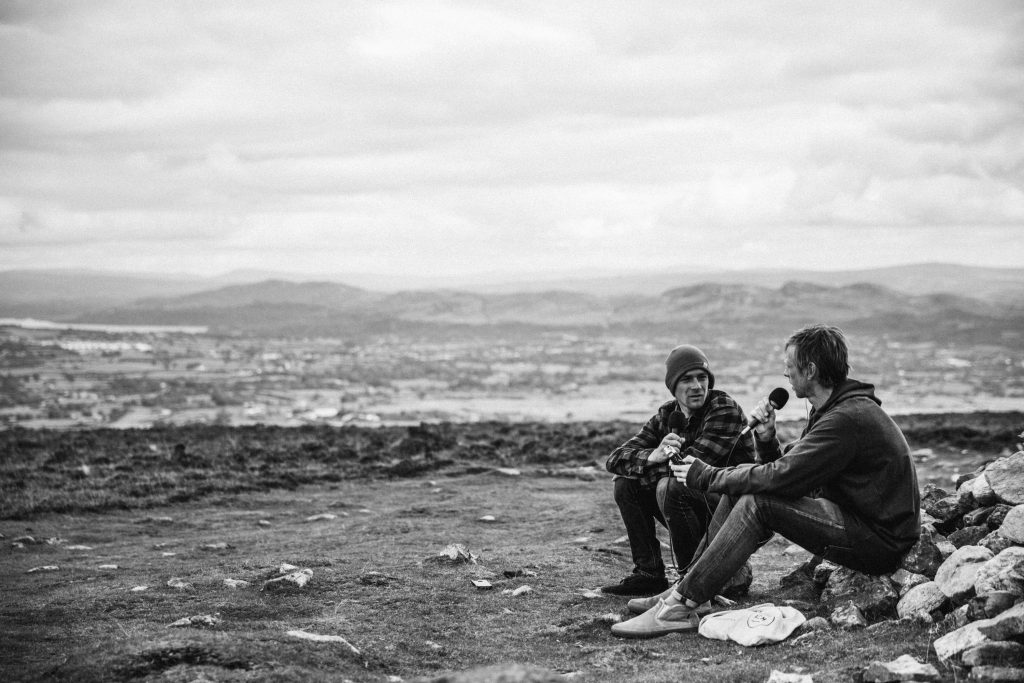
A podcast in the most unlikely of places. Photo: Owen Tozer.
BB: What is your stance on the lack of trust in government we have, and the power that companies have in our society now?
MB: One of the things I was ultimately interested in exploring was democracy. The mandate to make huge societal change is supposed to come from government, not from private individuals or companies. That’s one of the reasons why what’s going on in America right now is so incredibly topical.
But I think one of the ironies of the situation—and one of the things that commentators like tax expert like Chuck Collins and academic and author Carl Rhodes discussed with me in the podcast – is how most of the companies and industries that are held up as these vanguards of private enterprise are actually hugely subsidised by government money.
So this idea that the free market private companies operate independently from the government is just simply not true because all of them benefit from government money. Yet the way it’s discussed is that ‘we need to let businesses make the decisions because we don’t trust governments.’ Statements like that are intentionally misleading for a reason, because they tend to lead to further tax breaks for big companies.
Personally, I kind of agree with what Rhodes and Collins say in the podcast: yes, the systems that we have are not perfect; and clearly, in America, that system is very openly under attack. But I think this is still better than a private individual or an oligarch making decisions based upon their own self-interest. Or, worse, their ideology.
Sure, sometimes that self-interest might coincide with your self-interest. For example, if you’re left-leaning and you believe in the climate crisis, you’re going to agree with what Yvon Chouinard is doing.
But if a right-wing billionaire does something that you disagree with, like Elon Musk at the minute, then obviously that is not good news for you in the slightest, as the federal workers in the US are currently finding out.
But picking and choosing based upon whether the outcome favours us or not is how we’ve ended up here. And we should at least acknowledge that.
BB: You talk a lot in the podcast about modern corporate philanthropy and how it is evolving. How do you see that evolving, particularly when it comes to accountability, taxation and things like climate change?
MB: Corporate philanthropy and general philanthropy is basically when private individuals or organisations use their wealth to make change, for good or bad.
Yet the creation of these fortunes tends to have a huge impact on society, individuals, and workers’ rights. You can see that with any famous high-profile philanthropist throughout history. Even Patagonia are routinely criticised for the factories they use around the world, for example.
So there’s a bit of incongruity between ‘hey, we’ve made our fortune by massively impacting a huge amount of people in a negative way’ and ‘But now we’re going to use that fortune to positively impact a load of other people.’
This leads to the unpopular argument that is made around ‘decolonising’ philanthropy, discussed in the podcast by Immandeep Kaur, who makes a very progressive and left-wing argument that we redistribute wealth. Rather than let people have these vast fortunes, we should be changing wealth to benefit everybody more equitably.
But that is capitalism and it is the system we live in. And that’s why, to bring it back to Patagonia, it is significant what they’ve done. Because they are at least attempting to change that story.
I do have an issue with their claims that ‘this is going to change capitalism,’ but we cannot deny that for a business in their position, to decide to change that capitalist narrative, to profess that simply having green credentials like B Corp is not enough, is a profoundly significant thing.
That’s why people in philanthropy, people in climate activism, and people in business recognise this is a very big move and one that is worthy of our attention.
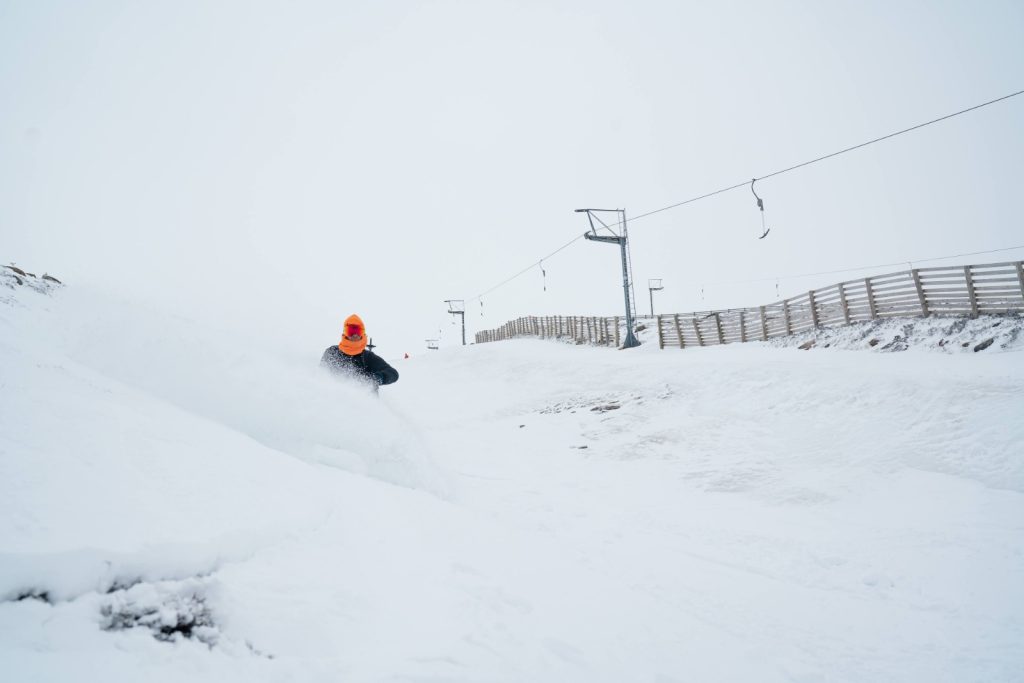
Not just a surfer, available for snow consultation too. Photo: Hannah Bailey.
BB: You see these days a lot of people think if they can’t be a perfect eco-being, there’s no point. How do you feel about that?
MB: If everyone had that attitude, we wouldn’t have abolished slavery in Western societies. We’d still be putting kids up chimneys. We wouldn’t have paid maternity leave, or the weekend, all of which were accomplished through protest and activism, and which we now all benefit from.
Of course, there are still huge issues of slavery and child exploitation around the world. But in progressive societies, where this conversation about how businesses can have an impact generally takes place, we don’t have child employment anymore. We don’t have kids working in factories. Women can vote.
Those things are relatively recent accomplishments, and they came about because people engaged in, to use the fashionable phrase, ‘imperfect activism.’ And we need more of it. Especially when there’s such a concerted effort to take these hard-earned rights away from us.
BB: We are nature and nature is us. We need to change the narrative, and not see it as separate from us. How do you feel about people making natural spaces a commodity?
MB: So I have quite an issue with the whole ‘nature is great for your mental health’ argument because I find that a bit of a weird idea that bodies of water, or woodlands exist simply so that that people can cold dip, or go for a wander, and then go away feeling better about their mental health.
It’s great if that’s working for you. But if that’s your only engagement with it, you’re commodifying something that actually needs a lot of support right now.
“Like you say, the commodifying of nature makes it all transactional. And I’m quite uncomfortable with that personally,” — Matt Barr
Take the water issue in the UK. What the water companies are doing in the UK is completely shocking, and it is basically down to the fact of companies making decisions based on what’s going to better their shareholder value, rather than what’s going to help the natural environment.
So you’d think those who use out waterways regularly might be out there advocating for that space. But that just doesn’t seem to be the case. For example, in Brighton, where I live, we have at least 200 regular surfers, and I’m going to say thousands of regular swimmers and water-users. And yet the last two SAS protests I’ve been to, there were about 50 people there. Whereas when we get a rare bit of groundswell, there’s going to be 200 people in that water.
Like you say, the commodifying of nature makes it all transactional. And I’m quite uncomfortable with that personally. Because people can go for a cold dip and congratulate themselves about how at one with nature they are – but what are they actually doing for the environment other than using it to meet their own needs?
BB: What’s next for The Announcement podcast? Or do you have any other projects in the pipeline?
MB: I’m continuing The Announcement as a follow up series. I’m going to be releasing new conversations that continue to explore the themes I began looking at here.
I do have an idea for another documentary series, which I’m gonna start thinking about how I can bring to life—ski lifts, as a way into the conversation around the impact of the climate crisis.
Ski resorts have always been islands for very rich people. But they’re becoming ever more like these hyper-capitalistic enclaves and with all the effect that’s having on local communities, jobs, social fabric, costs, house prices and so on. Like The Announcement, I think it’s a really interesting way into some important and hefty themes.